
Mosaic: a picture of five cards
Five cards laid out as one picture, and the story you tell from it.
The technique below lives inside Self-Work Navigator on our platform – open it and the steps walk you through automatically.
Open Self-Work NavigatorAbout this technique
Mosaic: a picture of five cards is a 20-minute self-reflection technique with metaphorical associative cards (MAC). Five cards laid out as one picture, and the story you tell from it. The session is designed to be run on your own, in your browser, without a therapist or a registration step.
It fits when the situation does not fit into words, and it has to be described. On the platform the steps walk you through automatically inside Self-Work Navigator, so you don't have to remember anything beyond the question you brought. We recommend starting with Urban Myth – it lands well for this kind of work.
When this technique fits
- The situation does not fit into words, and it has to be described.
- You want to look at something large as a whole rather than break it into parts.
- You need a way in when direct questions do not work.
When it doesn't fit
- If you need an answer to a specific question, take Three cards: a mosaic does not answer, it shows.
- If your thoughts are scattered right now and attention is hard to hold, five cards will be too much. Start with one.
- If the story starts living its own life and drifting far from your situation, stop: it is interesting, but it is no longer about you.
What you need
- 20 minutes alone.
- A scene deck.
- Space where five cards can lie together and be rearranged.
The layout
5 positions. Each one has its own question, and the card in it answers that question rather than the whole request.
- 1FirstWhat came first?
- 2SecondWhat stood next to it?
- 3CentreWhat ended up in the middle?
- 4EdgeWhat went to the edge?
- 5LastHow did the picture end?
How the session goes
-
1
Name what the picture is about
In one sentence: a year, a period, a relationship, work, a state. A mosaic works well with something large that is hard to break into points.
-
2
Pick five cards face up
Go through the deck and take the ones that respond, without explaining why to yourself. Five of them. Do not look for the right ones: look for the ones you cannot walk past.
- Which of the five came first?
- Which one surprised me?
-
3
Lay them out as one picture
Not in a row but as a picture: something in the centre, something at the edge, some cards closer together. Rearrange until the arrangement looks like the truth.
- What ended up in the centre?
- What went to the edge?
- Which two cards want to be next to each other?
-
4
Tell the story
Out loud or in writing, three or four sentences. As if you are explaining the picture to someone who cannot see it.
- Where does this story begin?
- How does it end?
- Who is the main character, if it is not me?
-
5
Bring the story back to yourself
The last step, the one everything was for: see where the story you told is about your situation.
- What in this story is true about me?
- What did I learn that I did not know before?
- What of the story can I change in my life?
Closing the session
Photograph the picture before you take it apart. In a month the photo shows what is invisible now: the arrangement of the cards is remembered worse than it seems.
If a lot came up
A picture sometimes assembles into a heavier story than you expected. That is a normal outcome, and you do not have to take it further alone. If it does not let go after the layout, come back to simple, physical things and leave the story for a conversation with a specialist.
Recommended decks
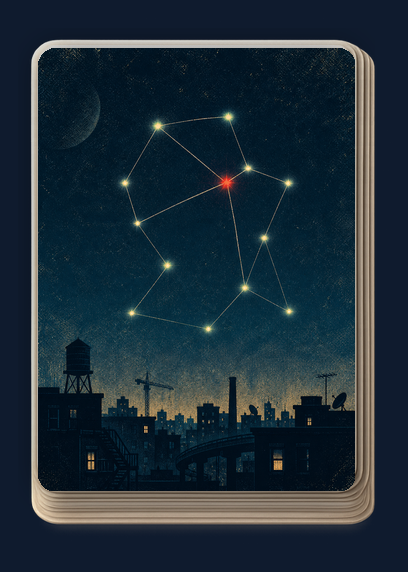


About metaphorical associative cards (MAC)
Metaphorical associative cards (MAC) are a projective tool used in self-reflection, coaching and therapy. Unlike tarot or oracle cards, they don't predict anything – the image becomes a mirror for what is already happening inside you, helping you put words on something that was unclear or hard to say directly.
You can work with MAC cards alone, with a therapist, or in a group. The card itself is not the answer; it is a frame for asking yourself a more honest question. The same image can mean very different things to two different people on the same day, and that is exactly what makes the tool work.