Resource state
Four cards along a rising line: your resource, how you switch it on, who supports it, and who you become in it.
The technique below lives inside Self-Work Navigator on our platform – open it and the steps walk you through automatically.
Open Self-Work NavigatorAbout this technique
Resource state is a 15-minute self-reflection technique with metaphorical associative cards (MAC). Four cards along a rising line: your resource, how you switch it on, who supports it, and who you become in it. The session is designed to be run on your own, in your browser, without a therapist or a registration step.
It fits when energy is low and you want to remember what actually gives it. On the platform the steps walk you through automatically inside Self-Work Navigator, so you don't have to remember anything beyond the question you brought. We recommend starting with Light Within – it lands well for this kind of work.
Questions this technique helps with
These are the kinds of questions people bring to this technique. If you recognise yours, you are in the right place.
- Resource state card layout. Four positions along a rising line: the resource, how to switch it on, who supports it and who you become in it.
- How to find your resource with cards. Cards here are picked with your eyes, not drawn blind: footing is recognised, not handed out at random.
- Cards before a difficult conversation. Fifteen minutes and four cards help you walk into the conversation with something in hand.
- Exercise to recover your energy. The layout ends with one sentence about yourself, easy to recall on a day with no energy.
- Gentle MAC layout for a first session. Low depth, nothing heavy comes up: a good first try if you are new to the cards.
- Four-card layout about inner footing. The «support» position checks separately whether there is a person, a place or an activity you can turn to.
When this technique fits
- Energy is low and you want to remember what actually gives it.
- Before a conversation or a task you are dreading.
- A first session with cards: the layout is gentle and brings up nothing heavy.
When it doesn't fit
- If the state is acute right now and images will not come together, start with the body: water, air, a short walk. Come back to the technique later.
- If no resource shows up three times in a row, that is not a flaw in the technique. A lasting sense that there is no footing at all is worth discussing with a therapist.
What you need
- 15 minutes in a quiet place.
- A deck with warm images: nature, states, light.
- Paper and pen if you want to keep what you found.
The layout
4 positions. Each one has its own question, and the card in it answers that question rather than the whole request.
- 1ResourceWhat makes me stronger?
- 2Switch onHow do I activate it?
- 3SupportWho or what supports me in it?
- 4StateWho do I become in it?
How the session goes
-
1
Card 1 chosen openly: my resource
Every card in this layout is picked with your eyes, not drawn blind. Footing is not handed out at random, it is recognised. Go through the deck and stop at the image that makes things a little calmer.
- What do I see here, and what exactly gives the footing?
- When in my life did I already have this state?
- How do I know it is in me?
-
2
Card 2 chosen openly: how to switch it on
The second position is the action or condition that brings you back into that state. Pick a card that looks like that switch.
- What do I have to do for this state to appear?
- How much time does it take me?
- What usually stops me from taking that simple step?
-
3
Card 3 chosen openly: who or what supports it
The third position. It can be a person, a place, an activity, a habit. What matters is that the support is real and available, not ideal.
- Who or what supports me in this state?
- When did I last turn to that support?
- What will stop me from turning to it again?
-
4
Card 4 chosen openly: who I become in it
The last position. Not a result or an achievement, but you in a resourced state. Look at the image longer than at the others and notice what the body does.
- What is different in me in this state?
- What becomes possible that was not possible on the first card?
- How will I know tomorrow that I am here?
-
5
Write one sentence for yourself
Fold the layout into a single sentence, for example: «My resource is quiet in the morning, it switches on in ten minutes without a phone, a walk supports it, and in this state I stop hurrying». That sentence is easy to recall on a day with no energy.
Closing the session
Leave the cards laid out for a minute and just look at the line from the first to the fourth. This layout is worth repeating every few weeks: a resource changes over time.
If a lot came up
Sometimes what arrives instead of footing is sadness about something long gone. That is not a failure: you found something important that you have no access to. Stay with it calmly, without conclusions. If the sense that there is no footing at all lasts for weeks, that is a conversation with a therapist, not a topic for the next layout.
Recommended decks

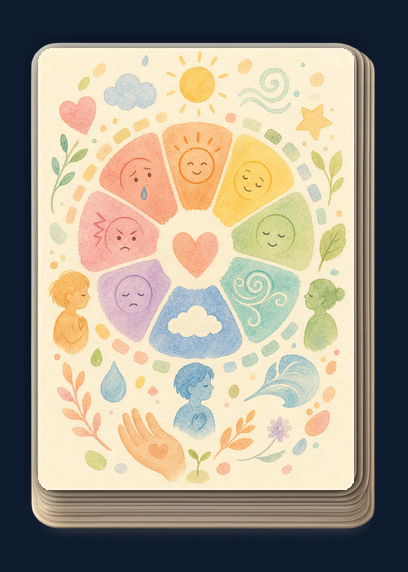

About metaphorical associative cards (MAC)
Metaphorical associative cards (MAC) are a projective tool used in self-reflection, coaching and therapy. Unlike tarot or oracle cards, they don't predict anything – the image becomes a mirror for what is already happening inside you, helping you put words on something that was unclear or hard to say directly.
You can work with MAC cards alone, with a therapist, or in a group. The card itself is not the answer; it is a frame for asking yourself a more honest question. The same image can mean very different things to two different people on the same day, and that is exactly what makes the tool work.